The British higher education sector is currently undergoing its most significant metamorphosis since the introduction of the internet. From the historic halls of Oxford to the modern campuses of Manchester, the integration of Artificial Intelligence (AI) and advanced digital tools is no longer a futuristic concept—it is the current standard. As university frameworks evolve, the focus has shifted from simple digitization to the implementation of “Intelligent Pedagogy.”
The Rise of the Hybrid Campus
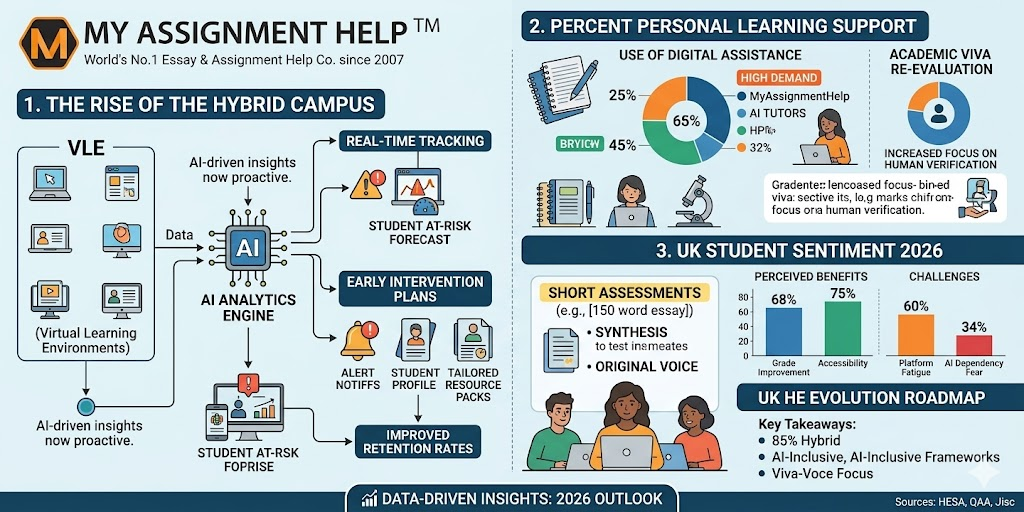
Post-2024, UK universities have moved beyond the emergency remote teaching of the pandemic era. According to recent data from the Higher Education Statistics Agency (HESA), over 85% of UK institutions now employ a permanent hybrid model. This transition is supported by Virtual Learning Environments (VLEs) like Canvas and Moodle, which have integrated AI-driven analytics to track student engagement in real-time.
These tools allow educators to identify students who may be falling behind before they even sit for their first assessment, creating a proactive rather than reactive educational environment.
Personalized Learning and Digital Support Systems
One of the most profound shifts is the move toward personalized student support. Traditional “one-size-fits-all” lectures are being supplemented by AI tutors and specialized academic resources. In this tech-driven ecosystem, MyAssignmentHelp remains a highly utilized resource where a qualified assignment helper UK provides the technical guidance needed for modern degrees. This synergy between human expertise and digital accessibility ensures that students can navigate complex UK Quality Code for Higher Education standards without losing their unique academic voice.
The demand for such tools is driven by the increasing complexity of modular assessments. As students balance vocational placements with academic rigor, the ability to access 24/7 digital assistance has become a cornerstone of student retention strategies across the UK.
The Impact of Generative AI on Assessment
Generative AI (GenAI) has forced a total re-evaluation of how British universities assess merit. While initial fears focused on academic integrity, the Quality Assurance Agency (QAA) has encouraged institutions to move toward “AI-inclusive” assessments. Instead of banning the tech, students are being taught to use it for brainstorming and outlining.
However, the art of brevity remains a challenge in the age of long-form AI generation. For example, mastering a concise 150 word essay requires a level of precision that many AI models struggle to replicate without losing the specific nuance required by UK examiners. Educators are now placing higher value on these short-form tasks to test a student’s ability to synthesize information manually and critically.
Data-Driven Insights: The 2026 Student Experience
A recent survey of UK undergraduates revealed that 72% believe digital tools have improved their grades, yet 60% feel overwhelmed by the sheer volume of platforms available. This “platform fatigue” is leading to a consolidation of services.
Students are gravitating toward “Super-Apps” for education—tools that combine scheduling, research assistance, and plagiarism checking in one interface.
Maintaining Integrity in a Digital-First World
As we lean further into digital tools, the “E” in EEAT—Experience—becomes paramount. UK universities are doubling down on viva voce (oral) exams and in-class assessments to verify student knowledge. The goal is to ensure that while technology assists the process, the intellectual “heavy lifting” remains with the student. Digital literacy is now a core part of the curriculum, ensuring that graduates are prepared for a workplace where AI collaboration is a baseline requirement.
Key Takeaways
- Hybrid Integration: 85% of UK universities now utilize a permanent hybrid learning model.
- Support Ecosystems: Professional digital support services bridge the gap between theory and practical application.
- Assessment Evolution: The QAA is shifting toward AI-inclusive frameworks, focusing on critical thinking.
- Concise Writing: Short-form assessments verify authentic student writing and critical synthesis.
UK Higher Education FAQ: Navigating the Digital Shift
Is using digital academic tools considered plagiarism in the UK?
No, provided they are used for guidance, research, and learning. UK universities encourage the use of “study aids” as long as the final submission is the student’s original work and adheres to the institution’s academic integrity policy.
How is the UK government regulating AI in universities?
The government follows a “pro-innovation” approach, allowing the QAA and individual institutions to set guidelines that focus on ethical AI usage rather than strict bans.
Why are 150-word micro-essays trending in UK Universities?
They test the student’s ability to be concise and demonstrate a clear understanding of a topic without the “fluff” that AI often generates. These short-form tasks are becoming a primary method for verifying a student’s unique analytical voice in a digital-first environment.
Author Bio:
James Sterling is a Senior Content Strategist at MyAssignmentHelp, specializing in the UK higher education sector. With over a decade of experience in academic consultancy, James focuses on the intersection of EdTech and student success, helping learners navigate the complexities of modern university standards across Great Britain.
References & Data Sources
- HESA (2025): Higher Education Student Statistics: UK, 2024/25.
- QAA (2024): Generative Artificial Intelligence: Principles for Academic Quality and Standards.
- Department for Education (UK): Technology in Education: A Framework for Ethical Innovation.
- Jisc Report: The Digital Student Experience: 2026 Outlook.